Choosing nylon fan blades means weighing the operating environment, the airflow requirement and the mechanical conditions together. What follows is a systematic approach to selection, covering the key parameters and our recommendations.
1. Define the application conditions first
Before choosing nylon fan blades, it is worth establishing the following basic parameters:
| Item | Description | Example |
|---|---|---|
| Operating environment | Indoor / outdoor / high temperature / corrosive | Engine bay, high-temperature workshop, cooling tower |
| Airflow requirement | How many cubic meters of air must move per hour | 10,000 m³/h |
| Static pressure requirement | How much system resistance there is (Pa) | 300 Pa |
| Drive type | Direct motor drive / pulley / hydraulic motor, etc. | Direct motor drive |
| Speed range | Motor speed or target speed | 1450 rpm |
| Mounting interface | Shaft diameter, keyway, bolt hole spacing | φ24mm shaft diameter |
| Noise requirement | Whether noise is a sensitive issue | Low-noise fan |
2. Main types of nylon fan blades
| Type | Features | Typical applications |
|---|---|---|
| Injection-molded nylon blades (standard) | Low cost, light weight, moderate strength | General ventilation and cooling equipment |
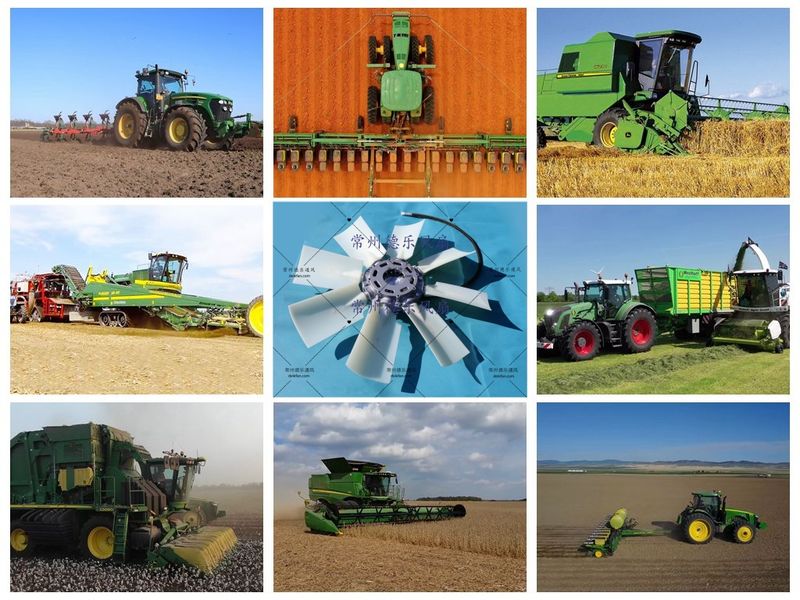
| Glass-fiber reinforced nylon blades (PA+GF) | High strength, heat resistance, fatigue resistance | Engine cooling, agricultural machinery, industrial fans |
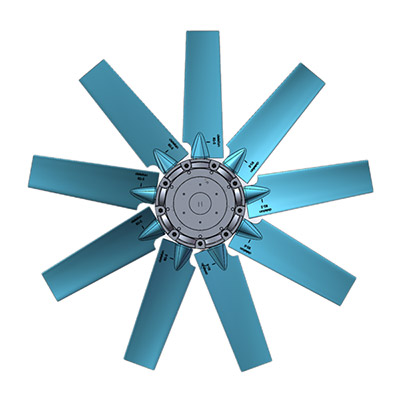
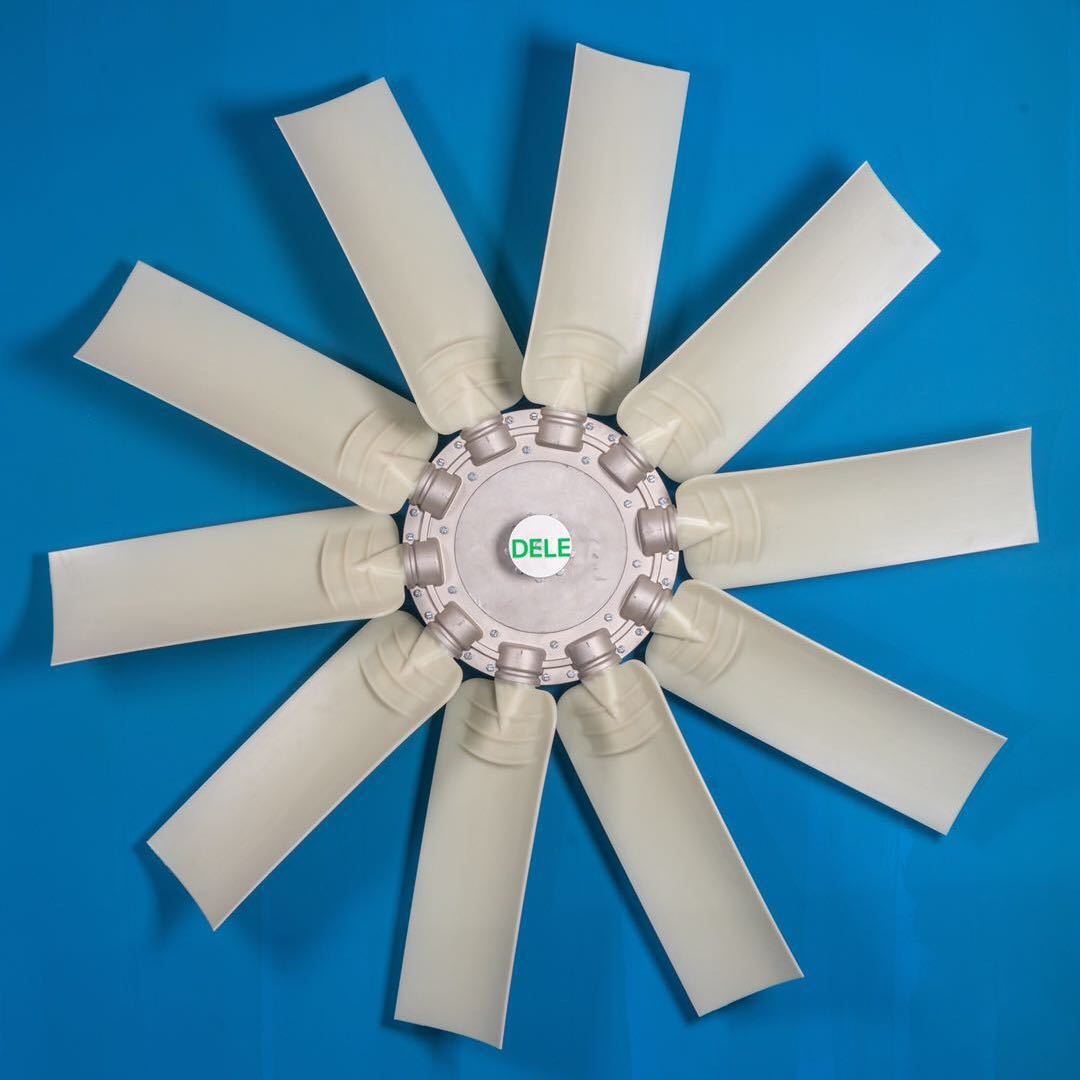
| Adjustable-pitch nylon impeller (modular design) | Blade angle can be adjusted, airflow can be tailored | Ventilation equipment, cooling towers |
| Anti-static nylon blades | Conductive fibers added to prevent static buildup | Dusty and chemical environments |
3. Selecting the key technical parameters
1) Diameter (D)
The main factor determining airflow.
Common range: 200 mm – 2200 mm.
2) Number of blades (Z)
Typically 3–9; more blades give higher airflow but also higher resistance.
Where noise is critical, a high blade count (9–16) can be used.
3) Blade profile (airfoil shape)
Forward-curved: high airflow and low noise; suited to low static pressure applications.
Backward-curved: high efficiency at high static pressure; used in high-resistance systems such as radiators and condensers.
Straight blade: simple construction, tolerant of dirt and easy to clean.
4) Material selection
Standard nylon (PA6): suitable for temperatures up to 80°C.
Glass-fiber reinforced nylon (PA66+30%GF): withstands 120°C.
For higher temperatures (>130°C), choose PBT or aluminum alloy.
5) Balance grade
G6.3 or better (ISO 1940) is recommended to keep vibration low and service life long.
4. Environmental factors and durability
| Operating condition | Recommended material | Notes |
|---|---|---|
| High temperature (>100°C) | PA66+GF or PBT | Standard nylon deforms easily |
| Corrosive gases | Corrosion-resistant or coated nylon | An anti-corrosion coating can be applied |
| Outdoor exposure | UV-resistant nylon | Prevents ageing |
| Dust-laden air | Anti-static nylon | Reduces the risk of dust buildup and ignition |
5. Matching motor power to airflow
The blade diameter must match the motor power, otherwise you will see:
Current too high → the motor is overloaded;
Current too low → energy is wasted.
Rule-of-thumb reference table:
| Motor power | Recommended impeller diameter (nylon) | Speed |
|---|---|---|
| 0.25 kW | 250–300 mm | 2800 rpm |
| 0.75 kW | 400–500 mm | 1450 rpm |
| 1.5 kW | 600–700 mm | 1450 rpm |
| 3 kW | 800–900 mm | 1450 rpm |
6. Summary of the selection process
Establish the required airflow and static pressure, then check the fan curve or the manufacturer's selection table;
Choose a suitable diameter, blade count and blade angle;
Confirm that motor power and speed are matched;
Confirm the material (whether glass-fiber reinforcement, UV resistance or high-temperature resistance is needed);
Choose a product with a high balance grade from a reliable brand.