Selecting a modular nylon cooling fan for an air compressor — particularly the oil and air coolers of a screw compressor — is essentially a matter of finding the best balance between cooling airflow, system resistance, structural strength and noise.
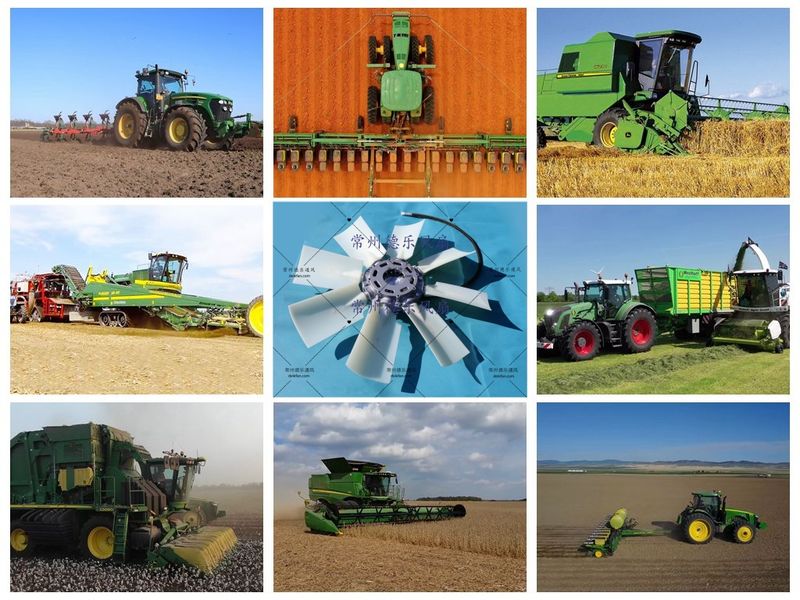
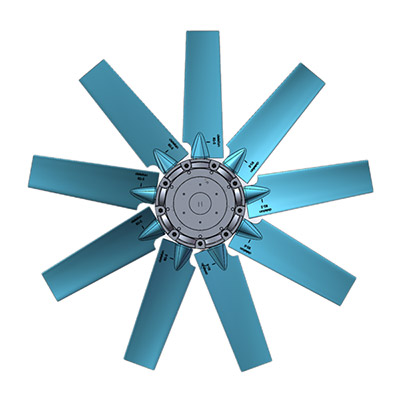
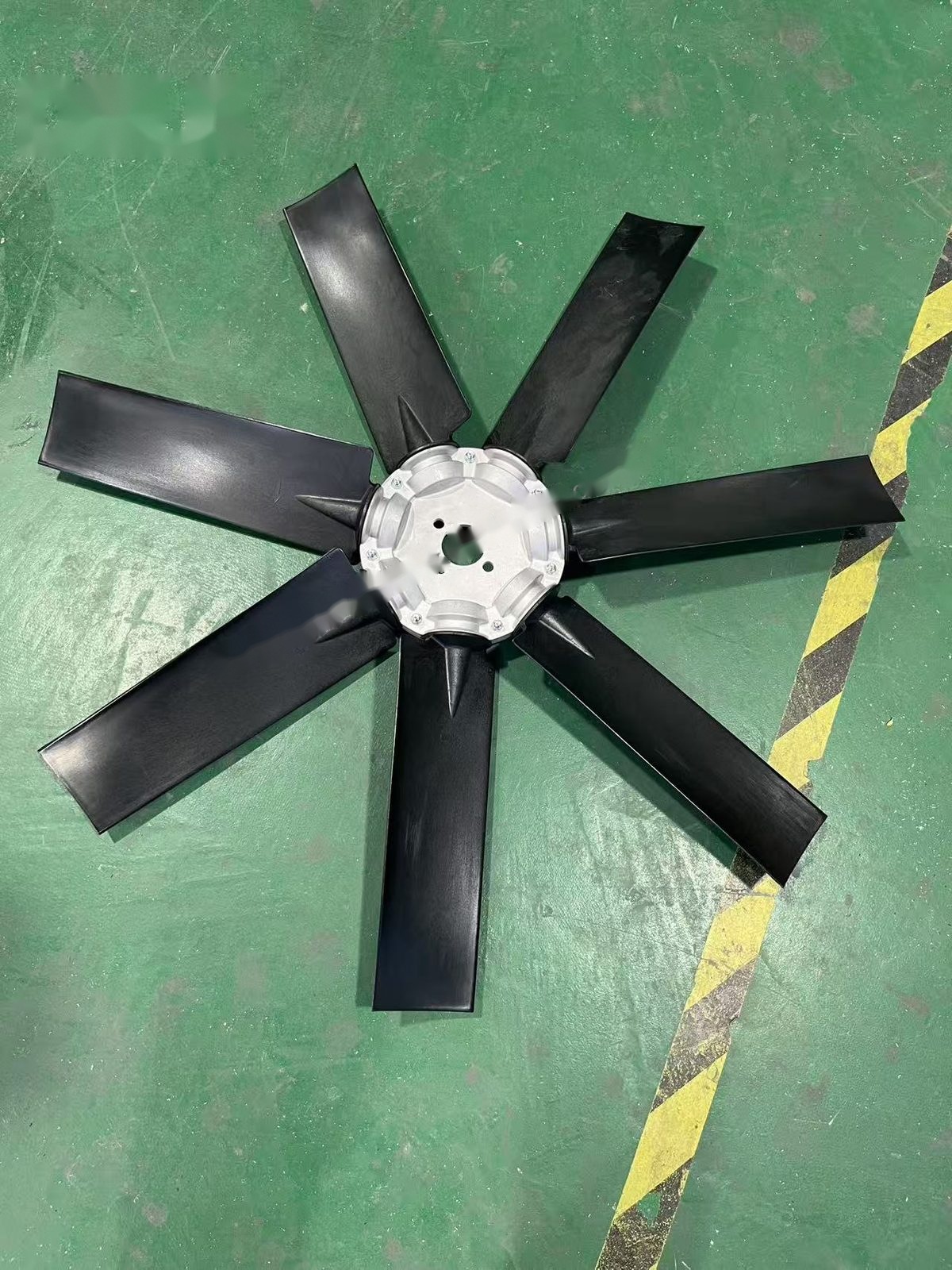
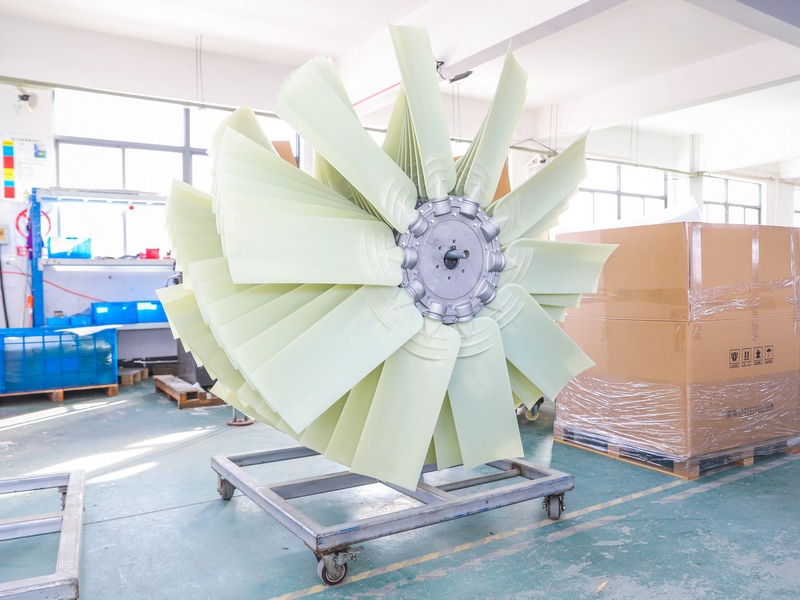
A modular nylon fan is usually assembled from a high-strength aluminium alloy hub and separate glass-fibre-reinforced nylon (PAG/PA6+GF) blades. Compared with a one-piece moulded fan, its advantage is that blade count, blade angle and airfoil can be adapted flexibly to the duty point. DELE modular nylon fans are already fitted to the great majority of mainstream compressors on the market, including Atlas Copco, Ingersoll Rand, Sullair, Bolaite, Fusheng, BSC, Kaishan and Jaguar, among other Chinese and international brands.
The specific selection steps and key factors are set out below:
1. Establish airflow and pressure (P-Q matching)
Fan selection cannot rely on "rated airflow" alone; it must be matched to the system resistance curve of the cooler (radiator):
(1). Cooling airflow (Q): calculate the required airflow from the heat load of the compressor. Heat dissipation is usually estimated at 8%–12% of the shaft power of the compressor's main motor, covering the heat that must be rejected by both the oil cooler and the air cooler.
(2). Static pressure / total pressure (P): cooler fins are closely spaced and create considerable air resistance, so the required fan pressure normally falls between 150 Pa and 450 Pa.
(3). Duty-point matching: the fan's operating point within its highest-efficiency region, usually the range where total pressure efficiency η>65%, must coincide with, or sit slightly above, its intersection with the resistance curve of the cooler.
2. Choose the modular construction and material specification
Blade material for standard duty: use PA6 / PA66 with 30% glass fibre (PAG). This composite offers excellent tensile strength and fatigue resistance, with a continuous service temperature range of -40°C to +110°C, which comfortably covers the high temperatures inside a compressor enclosure.
Explosion-proof / special duty: if the compressor is installed in a hazardous area such as a chemical plant or coal mine, an antistatic agent (carbon fibre or carbon black modification) must be added to the blade compound, and surface resistivity must reach <108Ω so that static charge cannot accumulate and spark.
Hub and blade count. Hub material: a high-strength die-cast or forged aluminium hub should be the first choice; it is rigid yet light, and effectively reduces the overhung load on the motor bearings.
Blade count and angle: modular fans are generally offered with 3, 4, 5, 6, 8, 9 or 12 blades, with the pitch adjustable over a 15°-50° range.
High pressure duty: increase the blade count or the mounting angle.
Low noise / low power duty: reduce the blade count and select a deeply curved airfoil.
3. Aerodynamic performance and low-noise optimisation
The cooling fan is one of the main sources of noise in a complete compressor package, so selection should focus on the following:
Blade profile: give preference to a forward-curved sickle airfoil or a three-dimensional twisted blade. Compared with a straight blade, the sickle profile spreads the aerodynamic load and effectively reduces rotational and vortex noise, typically by 3–5 dBA.
Tip clearance: the gap between the blade tip and the fan shroud should be kept at 0.5%–1.0% of the blade diameter. An excessive gap causes tip recirculation, which not only lowers aerodynamic efficiency but also triggers surging and additional noise.
4. Mechanical strength and safety limits
| Parameter | Selection and verification criteria |
|---|---|
| Tip speed limit | Tip speed v=π·D·n/60. Nylon blades should be kept below 70m/s (below 60m/s is recommended for standard conditions) to prevent centrifugal force from deforming or even shedding the blades. |
| Dynamic balancing grade | The fan assembly must be dynamically balanced to ISO 1940 G6.3 or better, so that vibration during long-term operation does not damage motor bearings or cooler welds. |
| Shaft bore fit and drive | The hub bore and motor shaft should be a close fit to H7/k6 or H7/m6, with keyway dimensions and the locking screw correctly aligned. |
The above is DELE Fans' summary of how to select a cooling fan for an air compressor. If you have a specific selection requirement, please contact our Manager Zou.